Welcome to Saved by Design
New Stuff:
In Home Page: Don’t Trash The HOME
In A Miracle Of Coincidence: “It is finished.”
In A Year In Lent: Only Consistency Allows Change
In Random Stuff: Sued
In Absence: Easters
In Left To Myself: Intrepid Explorers
In Emily’s Days: every nothing
In Not (As) Fat: One Meal A Day
In Finding Home: Occupation Preoccupation
In The Rules: 1) Plan. 2) Section. 3) Elevation
In Silence In Spring: Astonishing
In Days ’till Spring: “Karening”
HOME materials

NEW DAY!! 3rd Wednesday of The MONTH! May 15! NOON LIVE! 89.5FM STREAMING wpkn.org
It is easy to say “They don’t make’em like they used to.” And that, of course, for good or ill, is true. But there have been real improvements of some of the materials that can be used to make homes. Sixty years ago “Miracle” materials like aluminum siding, vinyl windows, asbestos entrained vinyl floor tile, sheets of wood pulp and glue, pressure treated wood foundations and popcorn ceiling surfacing. Oh, and electric resistance heat.
Those materials failed dramatically, and building codes have dramatically stiffened, raising costs, but often providing better built products. After 20 years, it may be that polyvinyl chloride (PVC) plastic trim and siding may just be a miracle material. Spray foam insulation has become necessary to meet energy codes. LED light fixtures are no longer blue death rays, but simulate natural or incandescant light at a tiny fraction of energy use. There are others, and HOME PAGE will have experts to opine on them!
Joining us are those who know building materials. Ben Bogie Director of Outreach & Education and Production Manager of BPC Green Builders in Ridgefield CT Builders of custom “green” homes. Steve Badanes is a Professor of Architecture, Director of the Neighborhood Design Build Studio at the University of Washington, and a partner in Jersey Devil Design Build, an architectural firm perpetuating the tradition of medieval craftsmen and Robert Swinburne Architect and principal of Bluetime Collaborative focusing on rural homes in New England located in Guilford, VT
JOIN US!
HOME design
LIVE! NOON! THURSDAY APRIL 25! WPKN 89.5fm STREAMING wpkn.org
We think about our homes because we want to manifest our values in them. So we try to control the ways our home’s accommodate our lives, but more, we want our homes to project our aesthetics. We can look at paint chips, take a weekend and colorize. We can stalk furniture on Amazon. We can visit special purveyors of special things. Most of us just do that.
But sometimes more is needed. More time, money and expertise. You could find a builder and point a finger a say: “FIX.” Or, you can gain the control of someone’s like mind and the knowledge base of a lifetime of manifesting possibilities. If you simply tell a builder “FIX.” you lose control. If a third party from you and the builder designs a scheme with you, you can see design options, determine what costs what and simply gain a level of control through the experience and expertise of those who earn a living designing homes.
But who do you hire?
Architects create buildings, in whole and in parts. Interior designers create the spaces we live in. Both are designers. But construction and finding the things we love are sliding scales of knowledge bases: Which realm of designing is right for the design of homes?
In this episode HOME PAGE will explore the differences between architects and interior designers: and we have two designers who work with both design professionals. Jack Franzen, FAIA has worked for over forty years to make beautiful homes – new, renovated, expanded – often with interior designers. https://www.franzenarchitects.com/ Juli Catlin, FASID is an interior designer who works on a wide variety of buildings, including homes – with and without architects https://www.catlindesign.com/
Architects, Interior Designers, and homes? Who does what and how can you use either or both?
Performance

Much of what I seem to do is to be in between. With the things I help build I am in between those who want and those who make. I am between experience and design for my students. I am often between an idea and those who read what I write. I stand between the natural world and plants I plant. Many of us have stood between our children (or later our parents) and the world. And when I am the producer of events I am between the act and the audience.
It occurs to me that I have produced a lot of “things.” But for reasons not clear I have been point on creating fifty – sixty? concerts, a bunch of plays, lectures, spoken word things, an arts festival, oh, and perhaps a hundred radio shows.
Last Saturday a couple of years of planning saw 500 folk come together to celebrate a man half of those there did not know – because they came to hear music they (and he) loved – and whose life is loved enough to celebrated by the other half. Endless meetings, arrangements, agreements, negotiations, artful ideations, and hard work by a lot of people made an event happen. Our love of the man made it happen.
That event is done. Others are coming.
But sometimes the most memorable moments for those who produce a performances have nothing to do with the joy of the performance. These moments happen because I am in between the event’s hopes and realizations – trying to make a connection. On the day of an event hundreds of connections are realized, so you often just wait for the outcome, attending to eventualities, then repairing the venue once done. But here, things happened.
The venue of the event is an 1816 church of great presence and history, so when open, people want to see its interior. That afternoon, four people in their 20’s walked up, visitors from somewhere – perhaps the middle east. “May we see?” “Sure.” A five minute tour, they were very happy, and walked out. They walked a few steps, and stared at the sign that showed the church’s service times. They were agitatedly talking.
I went out to ask why. One blurted, aghast, “What is this?” pointing to the Pride Flag quietly set below the schedule on the sign with “All Are Welcome” in tiny letters below it.
“How can you have this on a house of God?!”
“Its America.” I said.
“These things are prohibited by the word of God!”
“Not here. We are all children of God. Me and you.”
“This is wrong!”
“We are all children of God.” and I walk away.
They returned an hour later, and I was ready for a protest, but they walked away and nothing happened.
Later another one of those eventualities was when the group’s manager found me an an hour before the show, and breathlessly said “You must have a designated “Hearing Impaired” section!” I showed him our Handicapped Seating, right up front. “No! The signer must have direct visibility with those who cannot hear, and she has to sit Here.” (She turns out to be integrated into the show.)
”OK” since there were no reserved seating I reserved the best 4 seats in the house, directly in front of the group. I noted that no one had said that they needed them. The road manager’s response, “If no one says they need them before the show starts, anyone can sit there.”
A minute into the start of the program, two not-young women barely make it up the steps to the venue. They were breathless, and I note “The best seats are in the balcony!” They looked at me as if I was an idiot. And I was (9 steps were just too much for them, 19 more were not an option.)
“Wait!” I waived my hand and lead them through the packed house to the very front reserved seat, ripping off the “Reserved For The Hearing Impaired” sign: The last shall be first. There was overwhelming joy on their faces, throughout the concert.
Across the aisle from the magic seating of the tardy was a pew designated for the concert’s honoree, and guests. He had just conducted his choirs as the intro to the show, and had no idea of his honorific seating until he was forced to sit there, directly before the group he chose to perform – and now he was just another member of the audience: for the first time in forty years.
As I walked the house during the performance I was fully overjoyed, beyond any of the other events I have produced over the last fifty years, to see the honoree in his pew, with those he loved: and the joy on his face was the same as the elderly black women I had led to their magic seats across the aisle from him.
Because we all are children of God
in between

where we live
porch – living: stair
time
past – future: now
unknowable
family – fear: alone
devotion
beauty – failure: effort
distance
living – death: me
in between – always
What?

Things are Different.
In the 20th Century, things were More. In the 21st Century things are Different:
- In Manhattan, Dubai, London buildings happen from nowhere. Neither sculpture nor architecture, these buildings are “stuff”. Shapes are scaleless, no discernable size beyond big: with exteriors being wallpaper, or paint.
- In every medium-up sized place to live, the Box is eating landscape, killing buildings. Those exteriors are patchwork, often just shot-gunned windows with Contact Paper Skin.
- In Every Place Anyone Is Helped, when thanked, those helping used to say “Thank You.” Now they say either “Of Course.” or “Enjoy.”
- Back up car cameras cause cars to swing into parking spaces facing out, stopping those going in, but freeing those waiting for a space earlier than the back-up waiting of the 20th century.
- No one is admired beyond athletes, actors and musicians.
- Zoom.
- The weather is not as bad as advertised. Ever.
- Airports are nuts. More than again.
- Things that seem viable, close.
- Books are novels for Boomers.
- No Cheap Food.
- There is no “News” to “read”, we “hear” on screens.
- Weed smoke.
- Unused bike lanes
- Double parking
What did I Miss?
Couplet

In thy long Paradise of Light
No moment will there be
When I shall long for Earthly Play
And mortal Company —
Emily Dickinson #1145
40 of 40
We are sentenced to Mortal company, because, well, we are here. Emily Dickinson fully controlled that, living at home, connecting on paper with herself, then a small number of others.
In her control, she was free. In a day, a week, her mind went from doubt:
“Ourselves we do inter with sweet derision.
The channel of the dust who once achieves
Invalidates the balm of that religion
That doubts as fervently as it believes.”
To Faith:
”In thy long Paradise of Light
No moment will there be
When I shall long for Earthly Play
And mortal Company -“
And I am sure back again.
Our minds, the thing you are using now, sometimes cease reacting to beauty and fear and give the Earthly Play a break, absenting yourself from mortal Company to hold this time and place away from reaction – maybe to some understanding.
These 40 dances in dim silence, these pieces, attempts, are as incoherent in conclusion as Emily’s exquisite mind. 1145 attempts by Emily were held, (some just brushed against), and those 40, (those which I have no memory of before these days), attempted harmony. 854 to go next year.
Today is a day of incidence, the era, but this day – the oxymoronic Good Friday, where a future Good has naming rights to a day remembered for murder.
Couplets happen all the time: salt & pepper, Faith & fear, love & hate. The couplet of extreme humanity embodied in our profane acts – from Emily’s words to the cruelty of Good Friday is simply who we are. Like poems 1144 and 1145.
Conclusions are left to belief. The unavoidable truth is that meaning has to have Faith or there can be no meaning in the inscrutable world given to us. The only fact that AI and “trusting the science” cannot touch is the love each of us feels, right now.
It was given to us, you, me, by God, for me through Jesus. It is the truth that passes all understanding, and is our humanity, which lives it. A couplet of inscrutable reality that is unavoidable. This couplet completes next year.
WORD(s)

Ourselves we do inter with sweet derision.
The channel of the dust who once achieves
Invalidates the balm of that religion
That doubts as fervently as it believes.
Emily Dickinson #1144
39 of 40
There is credibility in uncertainty.
”Ourselves we do inter with sweet derision.”
When I am certain, knowing as assertion, I question. We now see videos, and immediately think AI changed them. Some think Apollo landed on a movie set.
Some now focus on events 2,000 years ago, that accounts of witnesses describe. In four voices. The same. Different. And however, whoever, the words are spoken by, the focus of the focus is relayed:
- Father, forgive them, for they know not what they are doing.
- Today, you will be with me in paradise.
- Behold your son: behold your mother.
- My God, my God, why have you forsaken me?
- I thirst.
- It is finished.
- Father, into your hands I commend my spirit.
It’s inconsistency is us. “That doubts as fervently as it believes.”
When we become believers, we lose Faith in our inconsistency. Belief unto fact means that 40% of us hate what another 40% of us love in America at this moment. It meant a Civil War during which Emily Dickinson wrote more poems than in any other time in the 40 years of their creation.
We cannot think without doubt so we try to find certainty in uncertainty. The other things around us can have joy in being, we need validity in knowing.
We cannot know what happened 2,000 years ago. Even AI does not offer a video. We live it’s consequences. More of us on earth, now, feel what those few felt, then, as do any other “believers” of other uncertainties.
Good marketing? Great benefits? Gullibility? Fear?
We get nothing out of believing anything beyond ourselves, but I think we cannot escape Faith beyond fear. We love when it is fruitless, we run away from possibilities. Our fear “Invalidates the balm of that religion” no matter what constructions we have made to believe. But Faith is not proud, reasoned, or even defendable.
We know our humanity, and we know Jesus, because he is human (whether God or not) because he is quoted to say
”Father, forgive them, for they know not what they are doing.”
and then, nearing death
”My God, my God, why have you forsaken me?”
and then
”It is finished.”
Because he is us. And we are what God made. And He knew that. We forget that. We doubt that. The things we make are not what we come to love “The channel of the dust who once achieves” is there, no matter the belief.
Our death will be a tiny thing in this maelstrom. But our life, our love we are given is overwhelming, despite us.
”Ourselves we do inter with sweet derision.
The channel of the dust who once achieves
Invalidates the balm of that religion
That doubts as fervently as it believes.”
Cross Carrying
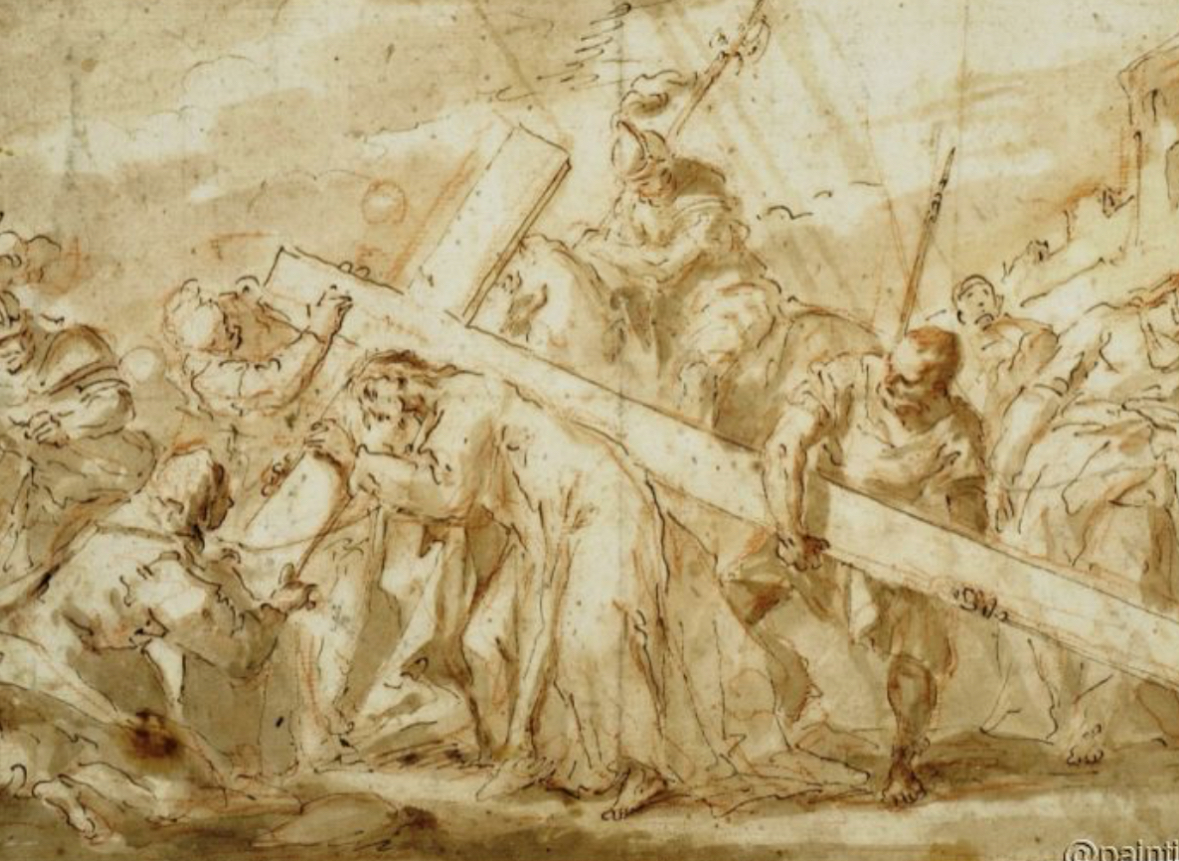
There is strength in proving that it can be borne
Although it tear —
What are the sinews of such cordage for
Except to bear
The ship might be of satin had it not to fight —
To walk on seas requires cedar Feet
Emily Dickinson #1113
38 of 40
My mother would sternly say “We all have our crosses to bear.” She would know, my father drank.
We would nod our small heads, as we were trying to carry the same cross.
It is the yearly week that some are literal in thinking about carrying a cross. Xeno, 300 years before Christ, defined the human quality of stoicism. Bearing a burden, suffering or sacrificing for a greater good.
I think of those crucified – those dying that day – and that an extra few hours of living was the greater good – rather than refusing to carry the cross and being put to death then and there. I think how the Romans wanted to publicly murder Jesus so badly that they forced Simon of Cyrene, Libya, to carry it when an old 33 year old in those days, could not. The fifth station of the cross.
But our “crosses to bear” are what we do not control. I am fat because I eat too much – no cross there. Several friends are dying in the near term, fully under the cross of bodies failing. But there is a middle cross.
”There is strength in proving that it can be borne”
It is the Xeno Stoicism that accepts the burden, because it means something to forebear it. I am being sued. It has been a burden for two years. I could have ended it by “settling”, but I cannot lie, even secretly. I have chosen that burden.
We decide to have children, and they are not us. We live lives that are not what we want. We do things that hurt us. All avoidable, all burdens. We make some crosses.
When I was completely full of my capacity – Football Captain, Ivy Bound, not fat – I listened to my father, before he had had today’s 12oz of VAT 69 Scotch, detail the endless frustrations of a life led below his hopes, his burdens of paying for us, of his anger at what he had chosen to do. I knew he meant drinking. But I looked at him hard in the eye (for once) and said “You do not have to do this. I can find a way to pay for Cornell. We can support you, just quit.”
He paused, shocked, as I meant it, happily accepting his burden. “You do not understand.”
And I did, and do, not.
”There is strength in proving that it can be borne”
The human Jesus did not want to die. He could not carry the cross. His mind in that day 2,000 years ago is a mystery. But the reality beyond that day is no mystery, it changed things. The sureties are derived from Faith – no matter the conviction.
I know that in the end, my father had no faith. He was carrying a cross and would die. I look at the cross of living and seem to have Faith for no reason. Because Faith has none. These recounted events, even my father’s rejection of anything but his cross, passes all understanding.
We can feel superior in our harrumphing judgment of others. Or we can know that we do not know them, and do know God. Because somewhere we know that we did not make ourselves, that there is no stoicism in the love we were given.
Easter has no cross, it has no burden other than we have to see beyond the jelly beans.
“Whose substances are sand—“

We do not know the time we lose—
The awful moment is
And takes its fundamental place
Among the certainties—
A firm appearance still inflates
The card—the chance—the friend—
The spectre of solidities
Whose substances are sand—
Emily Dickinson #1106
37 of 40
Someone sent Donald Trump Psalm 109 yesterday.
There was no thought of redemption, only of identification between a politician and Jesus in Holy Week, when persecution of the Divinely Innocent is welling up in the public consciousness.
I do not think anyone, including Donald Trump himself thinks that he is Divine. But we all think we are persecuted. We all hang hopes of meaning to the possibility that
”A firm appearance still inflates
The card—the chance—the friend—
The spectre of solidities…”
We look, this week, to dim history 2,000 years ago, and seek to see us in it. Of course it is, as history is just us, then. But of course it isn’t. We are not Divine, either.
But we are all – you, me, Jesus, Trump – God’s children. And we do come to hate each other. More in this season than in my memory.
More suicides, overdoses, murders, isolation – to the point of a bizarrely decreasing life expectancy. When we hate, we come to hate ourselves.
We were not made to hate, but can, or we would not know hate, like the lilies of the valley. But we do know hate. It is everywhere. It does not matter if our beliefs are righteous, it is now the norm to hate those who deny them.
Jesus did not hate his murderers.
I hate TV announcers. Really? When do I realize the fulsome waste of my humanity?
“We do not know the time we lose—
The awful moment is
And takes its fundamental place
Among the certainties—”
There is truth in us, we just have to hear it. The truth is not hate, fear is hate. Jesus knew fear 2,000 years ago, because he is us. He also knew God.
In the end, our end, the hate cannot keep us alive, justify us, or even make sense. The screaming noise of this moment crushes the love we were given, because we are sore afraid to simply live it. I am.
So I look to 2,000 years ago, now. The tiny death of one rabble rouser was nothing, until it was everything. Our love is meaningless in the screaming hatreds of this moment, until we understand it is the only meaning of the moment.
Especially this week.
Outside! HOME
LIVE! NOON! THURSDAY March 28 WPKN 89.5fm STREAMING http://www.wpkn.org
We are going outside again: the rain and the wind and the temperature may daunt our desires some days, but it is inevitable that we emerge: We extend our homes in the Spring. What can we do now that there is Post-Pandemic competition for our time?
Where are the opportunities? The dangers? The rethinking beyond gardens in the places we can make? What the sun, water, wind offer is fundamental, but can you look at the outdoor world as a series of places, rather that exterior decoration.
HOME PAGE will have lifelong exterior creators to muse about what they discovered in the land around them. Is food beautiful? Are flowers controllable? Is a lot of water a problem or an opportunity? What has the popular culture forgotten about how we can manifest our hopes in our landscapes?
We have Seattle architect Susan Ingham, who is thinks about our landscape in a different way: including how we design our ideas for our land and Nancy DuBrule-Clemente of Natureworks in Northford https://natureworksgardencenter.com/ Join Us!
































 Saved By Design